Bugvirus: Unlocking the Nostalgic Pixelated World
If you’ve ever found yourself missing the tactile click of a joystick or the 8-bit soundtracks of the early internet era, Bugvirus is likely the typography solution you’ve been searching for. This isn't just another display font; it is a deliberate homage to the dawn of digital design. In a landscape saturated with sleek, high-resolution sans serif fonts and elegant script fonts, Bugvirus offers a refreshing return to the grid. It captures the raw energy of retro gaming and the distinct aesthetic of early operating systems, providing a creative asset that feels both historically significant and surprisingly versatile for modern branding.
The Anatomy of a Pixel Typeface
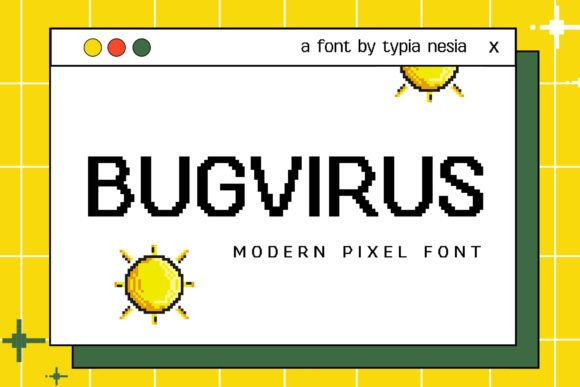
At its core, Bugvirus is defined by its construction. Unlike modern typography that relies on smooth curves and vector scalability, this typeface embraces the limitations of early screen technology. The characters are built on a rigid grid, resulting in a distinct blocky structure that immediately signals "digital." However, viewing Bugvirus simply as "blocky" misses the nuance of its design. The kerning and spacing have been carefully calibrated to ensure that these pixelated forms remain legible at various sizes, a common pitfall for many retro-style fonts.
The personality of Bugvirus is unapologetically technical yet playful. It carries a sense of urgency and action, reminiscent of arcade instructions or system error messages, but it can also be styled to feel whimsical depending on the color palette used. For designers working on logo design, this font provides a strong foundation for marks that need to stand out in a crowded market. It avoids the cold sterility of standard corporate typefaces, offering a texture that feels tactile and organic despite its digital origins. When you use Bugvirus, you aren't just choosing letters; you are adopting a specific visual language that speaks to a generation that grew up with dial-up modems and cartridge games.
Strategic Applications for Brand Identity
One of the most practical aspects of Bugvirus is its ability to anchor a brand identity in a specific, memorable aesthetic. For startups in the tech sector, particularly those dealing with cybersecurity, coding bootcamps, or indie game development, this font serves as an immediate visual cue of expertise and niche focus. It tells your audience that you understand the digital landscape because your branding literally speaks that language.
Consider the impact on packaging design. If you are selling energy drinks, tech accessories, or even craft beers targeting a younger, tech-savvy demographic, Bugvirus can transform a standard label into a collector's item. It adds a layer of authenticity that generic modern typography cannot replicate. Furthermore, in the realm of social media graphics, attention spans are short. The jagged, high-contrast edges of Bugvirus cut through the noise of a busy feed. It is excellent for headers, call-to-action buttons, or overlay text on video content where readability needs to be instantaneous and impactful.
However, context is everything. While Bugvirus is a powerful creative font, it is best utilized as a display font. Its intricate pixel details can become muddy if used for long-form body copy in small print sizes. Therefore, pairing it effectively is crucial for professional editorial design or web design. A common strategy is to pair Bugvirus with a clean, geometric sans serif font. The contrast between the rigid pixel grid of the header and the smooth legibility of the body text creates a dynamic visual hierarchy that guides the reader's eye naturally.
Technical Considerations and Pairing
When integrating a premium font like Bugvirus into your workflow, you need to evaluate the technical specifications to ensure it meets your project's demands. First, look at the included styles. Does the font family offer different weights or just a single style? Having access to a bold or condensed version of Bugvirus can significantly expand its utility across different media, from merchandise to digital ads.
Readability is the primary metric for evaluation. Test the font at the specific sizes you intend to use. For instance, if you are designing a mobile app interface, check how the pixel rendering holds up on high-DPI screens. Modern screens are incredibly sharp, which means pixel fonts can sometimes look too thin or jagged. You may need to apply slight CSS adjustments or choose a heavier weight to ensure the text remains accessible.
Licensing is another critical factor. If you are a freelancer or a small business owner, verify that the commercial font license covers your intended use cases. Does it allow for web embedding? Can you use it on unlimited print runs for merchandise? Understanding the license protects you legally and ensures you can scale your branding efforts without interruption.
Reviving the Digital Spirit
Ultimately, Bugvirus is more than a collection of pixels; it is a bridge between the past and the present. It allows creators to tap into the nostalgia of the 8-bit and 16-bit eras while maintaining the high standards of contemporary design. Whether you are a game developer aiming for an authentic retro look, a marketer crafting a campaign that needs to feel edgy and distinct, or a hobbyist creating custom invitations, this typeface offers a robust toolkit.
By choosing Bugvirus, you are making a deliberate stylistic choice that prioritizes character over conformity. It invites your audience to pause, remember, and engage. In a world of smooth gradients and minimalist sans serifs, sometimes the most professional thing you can do is embrace a little digital grit. Explore how this typeface can redefine your next project, and let the pixelated world inspire your next big idea.